

Sciatica - Wokingham, Berkshire
On this page
- Overview
- Symptoms
- Causes
- Sciatica in Chinese medicine
- Acupuncture for sciatica
- Sciatica acupuncture points
- Electroacupuncture for sciatica
- Cupping therapy for sciatica
- Chinese herbal medicine for sciatica
- Self-care tips
- Treatment at my clinic
- Frequently asked questions
- References
1. Overview
Sciatica is pain that radiates along the course of the sciatic nerve — the longest and widest nerve in the body — from the lower back through the buttock and down the back or outer side of the leg to the foot. It is one of the most common and disabling forms of nerve pain, affecting between 1.2 and 43% of the population at some point in their lives, with a peak incidence in the fourth decade of life. The term “sciatica” describes a symptom — pain along the sciatic nerve distribution — rather than a diagnosis in itself; the underlying cause is usually compression or irritation of one or more of the nerve roots that form the sciatic nerve (L4, L5, S1, S2, S3) as they exit the lumbar spine or sacrum.
Conventional treatment options for sciatica include advice to stay active, exercise therapy, painkillers (paracetamol, NSAIDs, opioids), muscle relaxants, corticosteroid spinal injections and, for persistent or severe cases, referral for surgery. However, there is a lack of strong evidence of effectiveness for most pharmacological interventions, and strong opioid pain relievers such as tramadol, while more commonly used for chronic sciatica, carry significant risks of side effects and addiction with long-term use. Many patients do not wish to take these medications long term and prefer effective alternatives. Acupuncture treats sciatic pain effectively without the side effects or addiction risks of medication. A systematic review and meta-analysis of 28 RCTs involving 2,707 participants found that acupuncture produced a significantly higher total effective rate than analgesics (RR=1.20), reduced VAS pain scores significantly (MD −1.78) and achieved a lower adverse-effect rate and lower relapse rate.
2. Symptoms
Sciatica produces a characteristic pattern of symptoms that follows the course of the sciatic nerve from the lumbar spine to the foot:
- Radiating leg pain — the hallmark symptom; pain that travels from the lower back (typically L4–L5 or L5–S1 level) through the buttock and down the back or outer side of the leg, often reaching the calf, ankle and foot; the pain may be described as shooting, burning, stabbing, electric or aching; it typically affects one side only (unilateral), though bilateral sciatica can occur
- Low back pain — pain in the lower back at the level of the compressed nerve root, often alongside the leg pain; the back pain of sciatica is typically worse with bending forward, sitting, coughing or sneezing, as these positions increase pressure on the compressed nerve root
- Numbness and tingling (paraesthesia) — pins and needles or numbness along the nerve distribution, most commonly in the outer calf, the top of the foot, the sole of the foot, or specific toes, depending on which nerve root is involved; L4 involvement typically produces symptoms along the inner shin and top of the foot; L5 along the outer calf and top of the foot; S1 along the outer foot and little toe
- Muscle weakness — weakness in the leg muscles supplied by the compressed nerve root; L4 compression causes weakness of the shin muscles (dorsiflexion); L5 compression causes weakness of the small muscles of the foot and the ability to extend the big toe; S1 compression causes weakness of the calf (plantarflexion) and the ability to stand on tiptoe; significant or progressive muscle weakness warrants urgent medical assessment
- Pain aggravated by sitting and bending — sciatic pain typically worsens with sitting, particularly on hard surfaces or during driving; bending forward, lifting and prolonged standing also aggravate the pain; lying down with the knees slightly bent often relieves the pain; the straight-leg raise test (raising the affected leg whilst lying flat) is a classical clinical test for sciatica
- Buttock and piriformis pain — deep pain or tenderness in the buttock, sometimes radiating from the piriformis muscle (piriformis syndrome); the sciatic nerve passes directly beneath or, in some people, through the piriformis muscle, and tightness or spasm of this muscle can compress the nerve, producing buttock and leg pain indistinguishable from disc-related sciatica
3. Causes
Sciatica arises when the sciatic nerve or the nerve roots that form it are compressed, irritated or inflamed. The most common causes are:
- Herniated (slipped) disc — the most common cause, accounting for around 85% of cases; when the soft gel-like centre (nucleus pulposus) of an intervertebral disc bulges or ruptures through the outer fibrous ring (annulus fibrosus), it can press directly on the adjacent nerve root; disc herniation most commonly occurs at L4–L5 or L5–S1, directly compressing the L5 or S1 nerve roots that form the sciatic nerve. See slipped disc
- Spinal stenosis — narrowing of the spinal canal or the lateral foramina (the openings through which the nerve roots exit) due to degenerative changes, thickened ligaments, or bony osteophytes; the narrowing reduces the space available for the nerve roots, producing compression and the characteristic symptoms of sciatica; spinal stenosis is more common in older adults and typically produces symptoms that worsen with walking and improve with sitting or bending forward (neurogenic claudication)
- Piriformis syndrome — tightness, spasm or inflammation of the piriformis muscle in the buttock, which can compress the sciatic nerve directly; piriformis syndrome is a common cause of buttock-dominant sciatic pain and is particularly well treated by acupuncture, as several key acupuncture points for sciatica (GB30/Huantiao, UB54/Zhibian) lie directly over or adjacent to the piriformis muscle
- Back injury and muscle tension — acute back injury or chronic muscle tension in the paraspinal and gluteal muscles can compress or irritate the sciatic nerve roots; poor lifting technique, sudden twisting movements and repetitive strain are common triggers; prolonged sitting (particularly in poorly supported positions or whilst driving) compresses the sciatic nerve and is a major aggravating factor
- Cold exposure — cold is a well-recognised trigger for sciatica flares; in traditional Chinese medicine, Cold invading the Gallbladder and Bladder channels (which follow the sciatic nerve distribution) constricts the channels and intensifies the pain; wearing thermals in cold weather is an important self-care measure to prevent cold-triggered flares
- Menstrual cycle — an interesting observation in clinical practice is the increased incidence of sciatica flares in female athletes and women with pre-existing sciatica during their menstrual cycle; in TCM, this is explained by the Liver governing the menstrual cycle and influencing its paired organ, the Gallbladder, whose channel travels along the same course as the sciatic nerve; hormonal changes also affect ligament laxity and pelvic biomechanics during the cycle. See also irregular menstrual cycle
- Stress — psychological stress increases muscle tension throughout the body, particularly in the paraspinal, gluteal and piriformis muscles; it also amplifies central pain sensitisation, increasing the perception of sciatic pain; managing stress is an important component of long-term sciatica management
- Excessive caffeine — coffee and excessive caffeine intake have been noted clinically to aggravate sciatic pain by increasing sympathetic nervous system tone, promoting muscle tension and dehydrating the intervertebral discs
4. Sciatica in Chinese medicine
In traditional Chinese medicine, sciatica is understood as a form of Bi syndrome (“painful obstruction”) in the Gallbladder and Bladder channels. The critical insight of TCM is that the pathway of the sciatic nerve corresponds almost exactly to the pathway of the Gallbladder meridian channel, which runs from the hip through the outer thigh and down the lateral leg to the foot. The Bladder channel runs from the lumbar spine through the sacrum, buttock and down the back of the leg, covering the posterior sciatic distribution. Stimulating acupuncture points along these channels in patients with sciatica directly addresses the obstruction of Qi and Blood flow that is producing the pain, numbness and weakness. The most common TCM patterns in sciatica are:
- Cold-Damp obstructing the Gallbladder and Bladder channels — the most common pattern, particularly in patients whose sciatica is clearly triggered or worsened by cold and damp weather; Cold and Damp pathogenic factors invade the channels, constricting them and preventing the free flow of Qi and Blood; the pain is typically a heavy, cold, aching sensation along the sciatic distribution that is relieved by warmth and worsened by cold; the Cold component causes the nerve channels to contract, intensifying compression; treatment expels Cold-Damp, warms the channels and restores Qi and Blood flow using warming needle moxibustion at GB30, UB54 and BL23, combined with the primary acupoints
- Liver-Gallbladder Qi stagnation — the pattern driving stress-triggered and menstrual-cycle-related sciatica; when the Liver Qi stagnates due to emotional stress, it directly affects its paired organ the Gallbladder and obstructs flow in the Gallbladder channel; this produces sciatic pain that worsens with stress, anger or emotional tension and is often associated with hypochondrial pain, irritability, mood changes and — in women — premenstrual worsening; treatment spreads Liver Qi, opens the Gallbladder channel and resolves Qi stagnation in the channel
- Kidney deficiency with channel malnourishment — the pattern in chronic, long-standing sciatica with associated lower back weakness, fatigue and constitutional depletion; the Kidney governs the bones and the lumbar spine; when Kidney Qi and Essence (Jing) are deficient, they fail to nourish the lumbar spine, the intervertebral discs and the nerve roots, making them vulnerable to degeneration and compression; this pattern is common in older patients and in those with disc degeneration or spinal stenosis; treatment tonifies Kidney Qi and Yin/Yang, strengthens the lumbar spine and nourishes the channels
- Blood stagnation in the channels — seen in post-traumatic sciatica following back injury, or in long-standing cases where the pain has become fixed, sharp and stabbing; when Blood stagnates in the channels following injury or prolonged obstruction, it produces a more intense, fixed pain that is worse at night and does not shift with position; treatment moves Blood, resolves stasis and opens the collaterals using moving points such as SP10 (Xuehai) and BL17 (Geshu) alongside the channel points
- Damp-Heat in the channels — less common; seen in patients with hot, burning sciatic pain accompanied by an inflamed, swollen-feeling leg; often associated with an underlying inflammatory condition or acute disc herniation with significant local inflammation; treatment clears Damp-Heat and opens the channels
5. Acupuncture for sciatica
Traditional acupuncture is very effective in relieving sciatica and reducing sciatic pain along the sciatic nerve pathway. The sciatic nerve distribution follows the same course as the Gallbladder and Bladder meridian channels; stimulating acupuncture points along these channels with electroacupuncture or manual needling directly unblocks the channels, reduces inflammation and restores blood flow to the nerve. Acupuncture relieves sciatica through several complementary mechanisms:
- Reducing nerve root inflammation and oedema — acupuncture reduces the local inflammatory response around the compressed nerve root — lowering prostaglandins, substance P and pro-inflammatory cytokines — which reduces the oedema (swelling) that worsens nerve compression and sensitisation in disc-related sciatica
- Releasing piriformis and gluteal muscle spasm — deep needling of the piriformis, gluteus medius and adjacent muscles directly releases the muscle tension and spasm that contributes to sciatic nerve compression in piriformis syndrome and muscle-tension-related sciatica; needling at GB30 (Huantiao) and UB54 (Zhibian) achieves this directly
- Stimulating endorphin and neurohumoral analgesia — acupuncture stimulates A-delta and C sensory nerve fibres, triggering the release of endorphins, enkephalins and other neurohumoral factors that close the pain gate, raise the pain threshold and reduce the central sensitisation driving chronic sciatic pain
- Improving local microcirculation — acupuncture improves blood flow and microcirculation to the nerve roots and surrounding tissues, reducing ischaemia, promoting disc and nerve repair and aiding the dispersal of inflammatory mediators
- Regulating the nervous system — acupuncture modulates sympathetic nervous system activity, reducing the muscle tension and nerve sensitisation that amplify sciatic pain, and downregulates the central pain processing abnormalities that perpetuate chronic sciatica
Research evidence
A systematic review and meta-analysis by Han et al. (2022), published in Complementary Therapies in Medicine, included 28 RCTs involving 2,707 participants and found that acupuncture produced a significantly higher total effective rate compared to analgesics (RR=1.20; 95% CI: 1.16–1.24), significantly reduced VAS pain scores (MD −1.78; 95% CI: −2.44 to −1.12) and significantly elevated the pain threshold (MD=0.93; 95% CI: 0.64–1.22), with lower adverse effects and relapse rates than analgesics. A systematic review and meta-analysis by Zhang et al. (2023), published in Frontiers in Neuroscience, included 30 RCTs involving 2,662 participants from 7 databases and concluded that acupuncture is an effective and safe treatment for sciatica that can be considered a suitable replacement for medicine treatment. An earlier systematic review by Qin et al. (2015, PMID 26425130) provided the foundational evidence base confirming the effectiveness of acupuncture for sciatica.
6. Sciatica acupuncture points
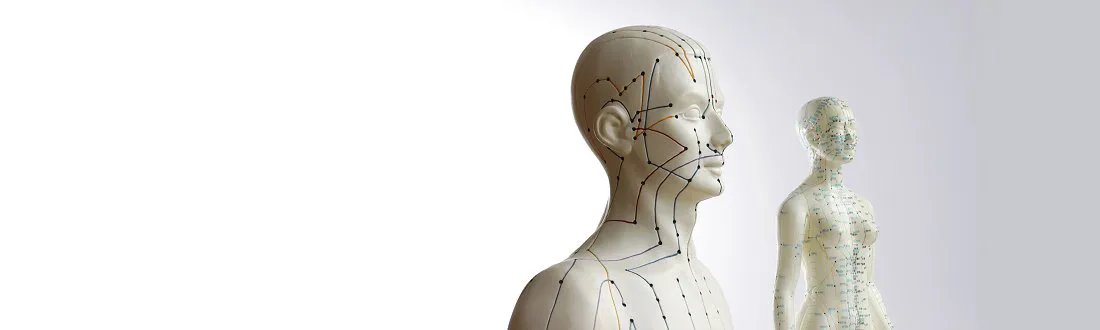
The main acupuncture points used to treat sciatica follow the Gallbladder and Bladder meridian channels along the sciatic nerve distribution. The principal points are:
- Baohuang — UB53 — located in the sacral region lateral to the sacrum at the level of the third sacral foramen; opens the sacral Bladder channel and treats deep sacral and buttock pain
- Zhibian — UB54 — located in the buttock at the level of the fourth sacral foramen, lateral to the sacrum; one of the most important local points for sciatica; lies directly over the piriformis muscle and sciatic nerve exit point; deeply needled with electroacupuncture for piriformis syndrome and deep buttock sciatic pain
- Huantiao — GB30 — located in the buttock at the junction of the outer third and medial two thirds of the distance between the greater trochanter and the sacral hiatus; the most important single point for sciatica in the entire acupuncture system; lies directly over the point where the sciatic nerve exits the greater sciatic foramen; produces a strong needle sensation radiating down the sciatic distribution; used in virtually all sciatica protocols
- Ciliao — UB32 — located in the second sacral foramen; treats lower back and sacral pain radiating into the leg; particularly useful when the root of the sciatica is at the sacral level (S1–S2)
- Fengshi — GB31 — located on the outer thigh, in the depression where the middle finger touches when the arm is held straight down by the side; opens the Gallbladder channel in the thigh; treats lateral thigh pain along the GB channel distribution
- Yanglingquan — GB34 — located in the depression anterior and inferior to the head of the fibula; the influential point for sinews and tendons in Chinese medicine; treats lateral knee pain and sciatic pain extending to the outer lower leg; one of the most important distal points for the Gallbladder channel
- Yangfu — GB38 — located on the outer lower leg, above the lateral malleolus on the fibula; the Fire point of the Gallbladder channel; treats lateral leg pain and sciatica extending to the foot
Additional points are selected according to the TCM pattern and the distribution of symptoms: BL23 (Shenshu) and GV4 (Mingmen) for Kidney deficiency patterns; LV3 (Taichong) and GB34 for Liver-Gallbladder Qi stagnation; BL40 (Weizhong) for posterior (S1) sciatic distribution; ST36 (Zusanli) and SP6 (Sanyinjiao) to tonify Qi and Blood in deficiency patterns. These are best administered by a qualified acupuncturist.
7. Electroacupuncture for sciatica
Electroacupuncture (EA) — the application of a small electrical current between pairs of needles — is particularly effective for sciatic nerve pain. Connecting electroacupuncture between GB30 (Huantiao) and UB54 (Zhibian), or between local and distal channel points, directly stimulates the Gallbladder and Bladder channels along the entire sciatic distribution. The electrical stimulation reproduces the “de qi” sensation (the therapeutic needle sensation of aching, tingling or heaviness that indicates channel activation) throughout the nerve pathway, providing more sustained and powerful analgesia than manual needling alone. Electroacupuncture is anti-inflammatory, reduces nerve oedema and restores blood flow to the compressed nerve root more effectively than manual acupuncture in acute and sub-acute sciatica. It is the treatment approach most consistently supported by the systematic review evidence for sciatic nerve pain.
8. Cupping therapy for sciatica
Cupping therapy — the application of suction cups to the skin — is an effective complementary treatment for sciatica, particularly for the muscular component of sciatic pain. It is frequently combined with acupuncture in the same treatment session. Cupping treats sciatica by:
- Releasing paraspinal and gluteal muscle tension — the suction effect of cupping deeply releases the tight paraspinal, gluteal, piriformis and hamstring muscles that contribute to sciatic nerve compression; this is particularly effective for piriformis syndrome and muscle-tension-related sciatica
- Moving Qi and Blood stagnation in the channels — cupping strongly moves Qi and Blood in the local channels, dispersing the stagnation that produces the aching, heavy, obstructed quality of chronic sciatica; in TCM terms, cupping “opens” the channels and collaterals along the sciatic distribution
- Reducing local inflammation and oedema — cupping promotes local blood flow and lymphatic circulation, helping to disperse the inflammatory mediators and oedema around compressed nerve roots and tight muscles
- Warming the channels — warming (fire) cupping combines the suction effect with heat, providing the warming channel action that is particularly important in Cold-Damp Bi patterns of sciatica
Cupping is applied along the lumbar spine, the sacroiliac region, the buttock and the outer thigh — following the Gallbladder and Bladder channel distributions. Sliding cupping (moving the cups along the channels whilst applied) is often used to treat the full extent of the sciatic pathway from the lower back to the thigh.
9. Chinese herbal medicine for sciatica
Chinese herbal medicine treats sciatica from the inside, prescribing daily herbal formulae that address the underlying TCM pattern driving the nerve pain. Herbal treatment provides continuous daily treatment between acupuncture sessions and is particularly valuable in chronic or recurrent sciatica. Classical formulae used include:
- Du Huo Ji Sheng Wan (Angelica Loranthus Pill) modifications — the most widely used classical formula for lower back and sciatic pain with Kidney deficiency; tonifies Liver and Kidney, nourishes Blood, strengthens the lumbar spine and sinews, and expels Wind-Cold-Damp from the channels and joints simultaneously; the principal formula for chronic, recurrent sciatica with lower back weakness and fatigue; contains Du Huo (Angelica pubescens), Sang Ji Sheng (Loranthus), Du Zhong (Eucommia), Niu Xi (Achyranthes), Xi Xin (Asarum), Qin Jiao (Gentiana macrophylla), Fu Ling (Poria), Rou Gui (Cinnamon), Fang Feng (Saposhnikovia), Chuan Xiong (Ligusticum), Ren Shen (Ginseng), Gan Cao (Licorice), Dang Gui (Angelica sinensis), Bai Shao (Paeonia) and Shu Di Huang (prepared Rehmannia)
- Juan Bi Tang (Remove Painful Obstruction Decoction) modifications — for Cold-Damp obstructing the channels; expels Wind-Cold-Damp, warms the channels and moves Qi and Blood to relieve the cold, aching, heavy sciatic pain that worsens in cold and damp weather; suited to Cold-Damp Bi patterns where thermals and warmth provide clear relief
- Shu Gan Wan (Liver-Soothing Pills) with Gui Zhi Fu Ling Wan modifications — for Liver Qi stagnation patterns with stress-triggered or menstrual-cycle-related sciatica; smooths Liver Qi, opens the Gallbladder channel and moves Blood stagnation in the pelvic channels
- Shen Tong Zhu Yu Tang (Drive Out Blood Stasis from a Painful Body) modifications — for Blood stagnation patterns with fixed, stabbing sciatic pain worsened by inactivity; strongly moves Blood, resolves stasis and opens the collaterals; contains Qin Jiao, Chuan Xiong, Tao Ren (Prunus persica), Hong Hua (Carthamus), Gan Cao, Qiang Huo (Notopterygium), Mo Yao (Myrrh), Dang Gui, Wu Ling Zhi (Trogopterus dung), Xiang Fu (Cyperus), Niu Xi and Di Long (Earthworm)
Herbs are prescribed as pharmaceutical-grade granules from Sun Ten (Taiwan), dissolved in warm water and taken daily. An online Chinese herbal consultation is available for patients who cannot attend the clinic in person.
10. Self-care tips
The following self-care measures help manage sciatica and complement acupuncture treatment. These are clinically evidenced recommendations based on TCM principles:
- Wear thermals in cold weather — wear thermal underwear and warm layers over the lower back, hips and legs when the temperature is below 10 degrees Celsius; Cold is one of the most potent triggers for sciatic flares, and keeping the lumbar and sacral channels warm prevents Cold invasion of the Gallbladder and Bladder channels; thermal leggings and lower-back warmers are particularly valuable
- Use heat — not cold packs — apply a hot water bottle or heat pad to the lower back and buttock for pain relief; heat relaxes the paraspinal and piriformis muscles, improves local blood flow and warms the channels; cold packs should be avoided for sciatica in TCM, as cold constricts the channels and worsens the underlying Cold-obstruction pattern driving most sciatica
- Avoid prolonged sitting — sitting compresses the sciatic nerve, particularly in the piriformis and gluteal region; stand up and move regularly if your work involves prolonged sitting; use a lumbar support and ensure your chair supports the natural lumbar curve; avoid sitting on hard, cold surfaces
- Avoid driving a manual car during a flare — using a manual (clutch) car during a sciatic flare repeatedly engages the piriformis and gluteal muscles, aggravating sciatic nerve compression in the buttock; if driving is unavoidable, stop and move frequently and use heat on the seat if possible
- Practise yoga or Pilates daily — gentle yoga and Pilates stretches that open the hip flexors, piriformis and hamstrings, and that strengthen the core and lumbar stabilising muscles, are among the most effective self-care measures for sciatica; specific stretches such as the pigeon pose (piriformis stretch), knee-to-opposite-shoulder, and supine spinal twists directly target the piriformis and gluteal muscles; avoid forward-folding poses that increase disc pressure during acute flares
- Avoid excessive caffeine — caffeine increases sympathetic tone, promotes muscle tension in the paraspinal and gluteal muscles and dehydrates the intervertebral discs; reducing coffee and caffeine intake is a clinically observed self-care measure that can reduce the frequency of sciatic flares
- Manage stress — stress increases muscle tension and central pain sensitisation, amplifying sciatic pain; regular acupuncture, mindfulness practice and adequate sleep all help to reduce stress-driven sciatic flares; in TCM, stress management directly addresses the Liver Qi stagnation pattern that underlies stress-triggered and menstrual-cycle-related sciatica
- Stay active — gentle, regular movement is more effective than bed rest for sciatica; walking, swimming and aqua exercises maintain movement in the lumbar and sacral channels, prevent muscle wasting and promote endorphin release; complete rest worsens sciatica by allowing the muscles to tighten and the channels to stagnate
11. Treatment at my clinic
I treat sciatica at my clinic in Wokingham, Berkshire. Treatment combines acupuncture, electroacupuncture, cupping therapy and, where appropriate, Chinese herbal medicine, tailored to the specific TCM pattern — whether Cold-Damp Bi, Liver-Gallbladder Qi stagnation, Kidney deficiency, Blood stagnation or Damp-Heat. Both acute and chronic sciatica are treated, including disc-related, piriformis syndrome and spinal stenosis presentations. Related conditions commonly treated alongside sciatica include back pain, nerve pain, slipped disc, muscle pain and pregnancy pain.
Visit the prices page for treatment costs or book an online Chinese herbal consultation if you cannot attend in person.
12. Frequently asked questions
Can acupuncture help sciatica?
Yes — acupuncture is one of the most effective treatments for sciatic nerve pain. A systematic review and meta-analysis of 28 RCTs involving 2,707 patients found that acupuncture produced a significantly higher total effective rate than analgesics (RR=1.20), significantly reduced VAS pain scores (MD −1.78) and achieved lower adverse-effect and relapse rates. A second SR/MA of 30 RCTs involving 2,662 patients concluded that acupuncture is an effective and safe treatment for sciatica that can be considered a suitable replacement for medicine treatment. Acupuncture works by reducing nerve root inflammation, releasing piriformis muscle spasm, stimulating endorphin release and restoring circulation along the sciatic nerve pathway.
What is sciatica?
Sciatica is nerve pain that radiates along the sciatic nerve from the lower back through the buttock and down the leg. It is caused by compression or irritation of the sciatic nerve or its roots (L4, L5, S1), most commonly by a herniated disc, spinal stenosis or piriformis syndrome. Symptoms include shooting leg pain, numbness, tingling and muscle weakness along the nerve distribution.
Why does sciatica worsen during the menstrual cycle?
In clinical practice, a significant number of women experience worsening sciatica around their menstrual cycle. In TCM, this is explained by the Liver governing the menstrual cycle and having a direct relationship with its paired organ, the Gallbladder. When Liver Qi stagnates due to hormonal changes or premenstrual emotional tension, it disrupts the smooth flow of Qi through the Gallbladder channel — which travels along the outer leg and follows the same distribution as the sciatic nerve — intensifying sciatic pain. Acupuncture treatment for menstrual-cycle-related sciatica targets both the Liver (LV3, LV8) and Gallbladder channel points to regulate the Liver-Gallbladder relationship and restore smooth Qi flow during the cycle.
Should I use heat or cold for sciatica?
Heat is preferable for most sciatica in TCM. The dominant underlying pattern in sciatica is Cold obstructing the Gallbladder and Bladder channels; cold packs worsen this obstruction. Apply a hot water bottle or heat pad to the lower back, sacrum and buttock for relief. Wearing thermals in cold weather and sitting on heat rather than cold surfaces are important preventive measures. The TCM recommendation to avoid cold packs for sciatica runs contrary to common advice for musculoskeletal pain, but accords with the clinical observation that most sciatica patients find heat relieves their pain and cold worsens it.
How many acupuncture sessions are needed for sciatica?
The number of sessions required depends on the severity, duration and underlying cause of the sciatica. For acute sciatica of recent onset, improvement is often seen within 4–6 weekly sessions. For chronic sciatica lasting months or years, or for disc-related or spinal stenosis presentations, a longer course of 8–12 sessions is typically needed, with the option of maintenance treatment thereafter. The systematic review evidence shows that the number of acupuncture sessions in studies ranged from 7 to 30, with longer courses generally producing better outcomes in chronic cases.















