

Traditional Chinese medicine (TCM)
On this page
- What is traditional Chinese medicine?
- History of traditional Chinese medicine
- Theory of traditional Chinese medicine
- Types of traditional Chinese medicine
- What are the benefits of traditional Chinese medicine?
- What conditions can traditional Chinese medicine treat?
- What happens during a TCM consultation?
- Is traditional Chinese medicine safe?
- Is traditional Chinese medicine research proven?
- Regulation and training
- How to find a qualified TCM practitioner
- Commonly asked questions about traditional Chinese medicine
- TCM glossary of terms
1. What is traditional Chinese medicine?
Traditional Chinese medicine (TCM) is the collective name given to a complete system of healthcare that originated in China and has been used continuously across East Asia for over 2,500 years. It encompasses a range of distinct but interconnected therapies — including acupuncture, Chinese herbal medicine, moxibustion, cupping therapy, dietary therapy and therapeutic exercise — all of which share the same underlying theoretical framework and diagnostic system.
Although the term "traditional Chinese medicine" implies a single Chinese origin, this system of medicine has been practised and refined across the whole of East Asia for millennia, influencing the development of distinct medical traditions in Japan, Korea, Vietnam and other Asian countries. It is more accurately described as East Asian medicine, though the term TCM has become the most widely recognised label in western countries.
TCM is one of the most widely practised complementary and alternative medicine systems in the world. In recent decades it has seen a dramatic increase in use across the UK, Europe, North America and Australia, driven by growing patient interest in holistic healthcare, the accumulating body of clinical research supporting its effectiveness, and its ability to treat conditions that are difficult to manage with conventional medicine alone.
2. History of traditional Chinese medicine
Traditional Chinese medicine has one of the longest continuous histories of any medical system in the world. Its origins lie in the observations and practices of ancient Chinese civilisation, accumulated over thousands of years before the development of a written theoretical framework.
The earliest written records of Chinese medicine date to the Shang Dynasty (1600–1046 BCE), where oracle bone inscriptions describe treatments for various diseases. The foundational classical text of TCM — the Huángdì Nèijīng (The Yellow Emperor's Classic of Medicine) — was compiled around 300 BCE and remains the most important theoretical work in the history of Chinese medicine. It laid out the core theories of yin and yang, the Five Elements, the meridian system, qi and blood, and the relationship between the human body and the natural world — concepts that still underpin TCM practice today.
Subsequent centuries saw the emergence of further foundational texts. Zhang Zhongjing's Shang Han Lun (Treatise on Cold Damage Disorders), written around 200 CE, established the system of pattern differentiation that forms the basis of TCM diagnosis. The Shénnóng Běncǎo Jīng (Shennong's Classic of Materia Medica) codified the properties and applications of hundreds of medicinal herbs. These texts were refined and expanded by generations of physician-scholars across the dynasties, producing a sophisticated and comprehensive medical system.
TCM spread throughout East Asia over the following centuries, influencing the development of Kampo medicine in Japan, Korean medicine, Vietnamese traditional medicine and Ayurveda in India. It was introduced to Europe through trade routes and became the subject of western scientific study in the 17th and 18th centuries. Over the last five decades, interest in TCM has grown rapidly in western countries, where it is now an established component of integrative healthcare.
3. Theory of traditional Chinese medicine
TCM is founded on a set of theoretical principles that provide a framework for understanding the human body, health, disease and treatment. These principles are not simply historical curiosities — they are the working diagnostic and therapeutic tools that TCM practitioners use in clinical practice every day.
Qi (vital energy)
At the heart of TCM theory is the concept of qi (pronounced "chee") — the vital energy or life force that animates all living things and flows through the body along a network of pathways called meridians or channels. Health is understood as a state in which qi flows freely and abundantly through the body's systems. Disease arises when qi is deficient, stagnant, misdirected or blocked. The primary aim of all TCM treatments is to restore the smooth, balanced flow of qi throughout the body.
Yin and yang
One of the most fundamental concepts in TCM is the theory of yin and yang — the two complementary and interdependent forces that govern all phenomena in the universe. Yin represents qualities such as coolness, darkness, stillness, nourishment and the feminine principle; yang represents warmth, light, activity, transformation and the masculine principle. In the human body, health depends on the harmonious balance of yin and yang. When this balance is disturbed — through excess or deficiency of either quality — disease results. TCM treatment works to restore this balance through the appropriate therapeutic interventions.
The Five Elements
The Five Element theory is one of the most important diagnostic and therapeutic frameworks in TCM. The Five Elements — Wood, Fire, Earth, Metal and Water — represent five fundamental phases of transformation and are used to describe the dynamic relationships between the body's organ systems, emotions, seasons and environmental factors.
Each of the five primary internal organ systems is associated with an element: the Liver with Wood, the Heart with Fire, the Spleen with Earth, the Lung with Metal and the Kidney with Water. These organs generate and control each other in a cycle of productive and regulating relationships. Each organ is also associated with a specific emotion — the Liver with anger and frustration, the Heart with joy, the Spleen with worry, the Lung with sadness and grief, and the Kidney with fear and willpower. Understanding the Five Element relationships allows a TCM practitioner to identify imbalances across multiple organ systems and treat the root cause of disease rather than simply addressing surface symptoms.
The meridian system
The meridian system is the network of channels through which qi and blood circulate throughout the body. There are twelve primary meridians, each associated with a specific internal organ, as well as eight extraordinary vessels and a network of subsidiary channels. The acupuncture points (acupoints) are specific locations along these meridians where the flow of qi can be accessed, stimulated and regulated by acupuncture, moxibustion or manual pressure.
Pattern differentiation
TCM diagnosis does not work by identifying a named disease in the western medical sense. Instead, a TCM practitioner gathers information through questioning, observation of the tongue, pulse-taking on both wrists and palpation of the body, and uses this information to identify the patient's individual pattern of disharmony — the specific combination of organ imbalances, qi and blood disturbances, and environmental influences that is producing their symptoms. Treatment is then directed at correcting this underlying pattern, which is why two patients presenting with the same western medical diagnosis may receive very different TCM treatments.
4. Types of traditional Chinese medicine
Traditional Chinese medicine encompasses nine distinct therapeutic modalities, all of which share the same theoretical foundation and diagnostic system. Most fully qualified TCM practitioners are trained in all of these therapies, though individual practitioners may specialise in particular areas.
- Acupuncture — the insertion of fine sterile needles into specific acupuncture points along the meridians to regulate the flow of qi and blood and restore balance within the body
- Moxibustion — the application of heat therapy using burning mugwort (ai ye) at or near acupuncture points to warm the meridians, dispel cold and strengthen yang qi
- Cupping therapy — the application of glass or plastic cups to the skin using vacuum suction to release muscle tension, improve circulation and remove stagnation
- Gua sha — a technique in which a smooth-edged tool is used to scrape the surface of the skin to stimulate circulation, release muscle tension and move stagnant qi and blood
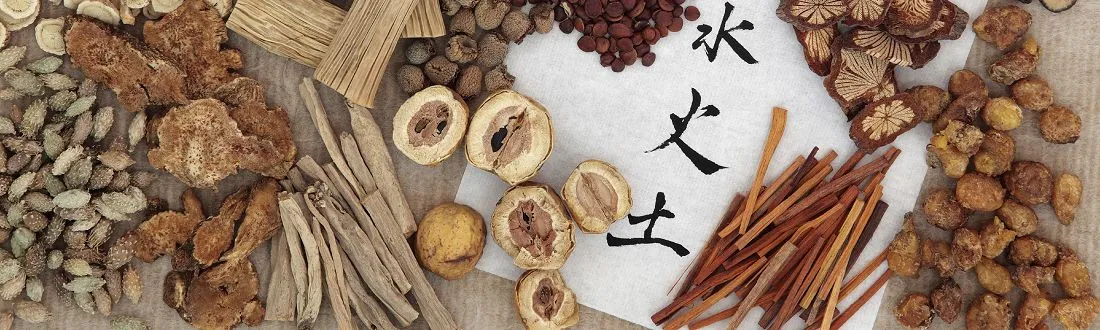
- Chinese herbal medicine — the prescription of bespoke formulas using medicinal plants, roots, bark, seeds and fungi to nourish, regulate and rebalance the body's internal organ systems
- Tuina (Chinese therapeutic massage) — a system of manual therapy that uses specific hand techniques applied to acupuncture points and meridians to regulate qi, relieve pain and restore musculoskeletal balance
- Chinese food therapy — the use of specific foods and dietary principles derived from TCM theory to support health, prevent disease and enhance the effects of other treatments
- Chinese lifestyle optimisation — guidance on sleep, exercise, emotional wellbeing and daily routines in accordance with TCM principles and the natural rhythms of the body and the seasons
- Qi gong and tai chi — meditative movement practices that cultivate and regulate qi within the body, strengthen the constitution and promote long-term health and vitality
5. What are the benefits of traditional Chinese medicine?
The defining characteristic of TCM as a therapeutic system is its holistic approach. Rather than treating individual symptoms in isolation, TCM addresses the whole person — physical, emotional and constitutional — and seeks to correct the underlying imbalances that give rise to disease. This means that patients frequently experience improvements across multiple areas of their health simultaneously, even in areas they had not specifically sought treatment for.
The key benefits of traditional Chinese medicine include:
- Treatment of the root cause of disease, not just the suppression of symptoms
- A genuinely holistic approach that considers the physical, emotional and constitutional dimensions of health together
- Effective treatment of chronic pain conditions that are difficult to manage with pharmaceutical medication alone
- Support for fertility in both men and women, including during IVF
- Management of chronic health conditions including anxiety, insomnia, IBS and menopausal symptoms
- Safe and effective treatment during pregnancy, including for breech presentation, morning sickness and pregnancy pain
- Support for recovery from illness, surgery and the side effects of chemotherapy
- Strengthening of immune function and increased resistance to recurrent infections
- Improved energy levels, sleep quality and digestive function
- Greater emotional stability and resilience, including reduction of stress and depression
- Very low risk of serious side effects when practised by a fully qualified and registered practitioner
- Complementary use alongside conventional western medicine, enhancing outcomes without interfering with existing treatments
6. What conditions can traditional Chinese medicine treat?
Traditional Chinese medicine has been used to treat a remarkably broad range of health conditions across thousands of years of clinical practice. In modern terms, it is particularly effective for conditions that are chronic, complex or difficult to treat with conventional medicine, as well as those where pharmaceutical options carry significant side effects.
The World Health Organisation (WHO) recognises acupuncture as an effective treatment for a range of conditions. Evidence from clinical trials supports the use of TCM therapies for:
- Back pain, neck pain and sciatica
- Headaches and migraines
- Muscle pain, frozen shoulder and sports injuries
- Arthritis and joint pain
- Female and male infertility, including support for IVF
- Breech presentation in pregnancy
- Anxiety, depression and stress
- Insomnia and sleep disorders
- Menopausal symptoms including hot flushes and night sweats
- IBS and other digestive disorders
- Acne and skin conditions
- Fibromyalgia and chronic fatigue syndrome
- Tinnitus
- Raynaud's disease
- Long COVID
- Burn out and adrenal fatigue
- Recurrent infections and immune deficiency
- Side effects of chemotherapy and cancer treatment
For a full list of conditions I treat, please visit the health conditions page.
7. What happens during a TCM consultation?
A TCM consultation is quite different from a conventional western medical appointment. Rather than focusing narrowly on the presenting complaint, I take a comprehensive view of the patient's whole health — physical, emotional and constitutional — in order to identify the underlying pattern of disharmony that is driving their symptoms.
At your first appointment, which typically lasts 60 to 75 minutes, I will ask detailed questions about your main complaint and its history, your general health, sleep, digestion, energy levels, emotional wellbeing, diet, lifestyle and any other relevant factors. I will also carry out two of the most distinctive diagnostic procedures in TCM: examination of your tongue, whose colour, coating and shape provide detailed information about the state of your internal organs; and pulse-taking on both wrists, where twelve distinct pulse positions can be felt, each corresponding to a different organ system.
From this comprehensive assessment, I will identify your individual pattern of disharmony and formulate a tailored treatment plan. Depending on your condition, this may include acupuncture, Chinese herbal medicine, moxibustion, cupping therapy, dietary advice or a combination of these therapies. I blend the principles of western science and traditional Chinese medicine to deliver a complete and evidence-informed system of healthcare.
Follow-up appointments are shorter — usually 45 to 60 minutes — and allow me to review your progress, adjust the treatment as your health improves and address any new concerns that have arisen since the previous session.
8. Is traditional Chinese medicine safe?
When practised by a fully qualified and registered practitioner, traditional Chinese medicine is very safe. The individual therapies that make up TCM — acupuncture, Chinese herbal medicine, cupping therapy and moxibustion — all have excellent safety records when used correctly, and the risk of serious adverse events is very low.
The majority of adverse events reported in relation to TCM are associated with practitioners who have received inadequate training — for example, healthcare professionals who have attended short introductory courses in acupuncture or dry needling without completing a full TCM qualification. With a fully trained and registered practitioner, serious side effects are extremely rare.
Chinese herbal medicine is safe when prescribed by a qualified herbalist using properly regulated, quality-tested herbs. All herbs imported into the UK are tested for toxicity, heavy metals and adulterants by the Medicines and Healthcare products Regulatory Agency (MHRA). The herbs I use come from Sun Ten in Taiwan, a world-leading manufacturer of pharmaceutical-grade herbal granules.
TCM is safe to use during pregnancy when the practitioner is trained and experienced in treating pregnant women. Acupuncture and moxibustion in particular are widely used in pregnancy to treat conditions including morning sickness, pregnancy pain and breech presentation, and are recommended by the NHS for antenatal support.
9. Is traditional Chinese medicine research proven?
There is a substantial and growing body of high-quality clinical research supporting the effectiveness of traditional Chinese medicine for a wide range of conditions. The evidence base for acupuncture in particular is now very strong, with numerous systematic reviews and randomised controlled trials demonstrating its effectiveness for chronic pain, fertility, anxiety, insomnia, menopausal symptoms and many other conditions.
The National Institute for Health and Care Excellence (NICE) recommends acupuncture for chronic primary pain. The NHS recognises acupuncture as an effective treatment and it is available in many NHS GP practices, pain clinics and hospitals across the UK. The National Institutes of Health in the USA lists evidence-based systematic reviews supporting the therapeutic benefits of TCM therapies for many health problems.
The evidence base for Chinese herbal medicine is also considerable. Many of the most important pharmaceutical drugs in use today are derived from compounds first identified in plants used in Chinese herbal medicine — including aspirin (derived from willow bark, used in TCM for thousands of years), artemisinin (from Artemisia annua, used to treat malaria, for which its discoverer Tu Youyou received the 2015 Nobel Prize in Medicine) and numerous cancer and cardiovascular drugs.
Research into moxibustion has demonstrated its effectiveness for breech presentation, with clinical trials reporting success rates of up to 72.5% in turning breech babies. Research into cupping therapy supports its use for musculoskeletal pain and sports recovery. You can read the latest research across all TCM modalities at Acupuncture Times.
10. Regulation and training in traditional Chinese medicine
The regulation of traditional Chinese medicine varies considerably across different countries. In China, Hong Kong, Australia, Canada and several East Asian countries, TCM is statutorily regulated and practitioners must meet defined standards of training and registration before they are permitted to practise. In the UK and most of Europe, TCM is not yet statutorily regulated, which means that anyone can legally offer TCM treatments regardless of their level of training.
In the UK, the best indicators of a properly qualified TCM practitioner are membership of the British Acupuncture Council (BAcC) — which requires a minimum of 3,000 hours of training and is overseen by the Professional Standards Authority — and, for practitioners who also prescribe Chinese herbal medicine, membership of the Register of Chinese Herbal Medicine (RCHM). I personally support the statutory regulation of TCM in the UK, and believe that stronger regulatory standards would better protect patients and raise the quality of practice across the profession.
My own training was a full five-year degree in traditional Chinese medicine — the same standard as medical training in China — which involved over 3,500 hours of study and clinical practice. This is significantly more than the three-year part-time degrees completed by many practitioners in the UK. My clinical training took place at Whittington Hospital in London and at Zhong Ri Hospital and Xi Yuan Hospital in Beijing. I am a fully registered member of both the BAcC and the RCHM.
11. How to find a qualified TCM practitioner
Because traditional Chinese medicine is not yet statutorily regulated in the UK, it is important to know what to look for when choosing a practitioner. The following criteria will help you identify a properly qualified and trustworthy TCM practitioner.
For acupuncture: Look for a member of the British Acupuncture Council (BAcC). BAcC members have completed a minimum of 3,000 hours of training — equivalent to a three-year full-time degree — and are bound by a strict code of professional conduct. Always ask how many hours of training a practitioner has completed. Traditional TCM acupuncturists train for 3,000 to 3,500 hours; practitioners who perform dry needling after a short weekend course may have as few as 30 to 300 hours of training.
For Chinese herbal medicine: Look for a member of the Register of Chinese Herbal Medicine (RCHM). RCHM members have undergone rigorous training specifically in Chinese herbal medicine and are required to maintain professional indemnity insurance and commit to ongoing continuing professional development.
For integrated TCM treatment: Seek a practitioner who holds qualifications in both acupuncture and Chinese herbal medicine and is registered with both the BAcC and the RCHM. This dual qualification enables the practitioner to offer the full range of TCM therapies and to combine them in the way that best serves each individual patient's needs.
I hold qualifications in both acupuncture and Chinese herbal medicine, am a registered member of both the BAcC and the RCHM, and have over 25 years of clinical experience in traditional Chinese medicine. I practise at clinics in Wokingham, Berkshire, and offer online consultations for patients worldwide.
12. Commonly asked questions about traditional Chinese medicine
What is the difference between TCM and western medicine?
Western medicine excels at acute care, surgery, emergency treatment and the management of serious infectious disease. TCM works differently — it takes a holistic view of the patient, treats the underlying cause of illness rather than suppressing individual symptoms, and uses natural therapies that work with the body's own healing mechanisms. The two systems are not mutually exclusive. In my practice, I blend western science and TCM together to deliver a complete system of healthcare, and many of my patients use TCM alongside their conventional medical care to achieve better overall outcomes.
How long has traditional Chinese medicine been used?
Traditional Chinese medicine has been used continuously for over 2,500 years, making it one of the oldest surviving medical systems in the world. The foundational theoretical texts date to around 300 BCE, though the empirical observation and practice that underpins TCM goes back considerably further. It has been refined across more than two millennia of continuous clinical use, producing one of the most sophisticated and comprehensive systems of healthcare ever developed.
Can TCM be used alongside conventional medicine?
Yes — TCM is entirely compatible with conventional western medical treatment and is frequently used alongside it. Many patients come to me while continuing to take prescribed medication or receive other conventional treatments. TCM can complement and enhance the effects of conventional care, help manage the side effects of pharmaceutical drugs or other treatments, and address aspects of health that conventional medicine struggles to treat effectively. I always ask patients about all medication and treatments they are currently receiving and take this into account in formulating my TCM treatment plan.
Is TCM only for physical health problems?
No — TCM takes a holistic view of health that encompasses physical, emotional and mental wellbeing. Many of the conditions I treat most frequently have a significant emotional or psychological component, including anxiety, depression, stress, insomnia and burn out. TCM views the mind and body as an inseparable whole and treats them as such.
How is a TCM diagnosis made?
TCM diagnosis uses four primary methods: questioning (asking detailed questions about symptoms, lifestyle and general health), observation (examining the patient's complexion, tongue, posture and demeanour), listening and smelling (assessing the quality of the voice and any significant bodily odours), and palpation (taking the pulse at twelve positions on both wrists and examining areas of the body relevant to the complaint). From these four sources of information, the TCM practitioner identifies the patient's individual pattern of disharmony and formulates a tailored treatment plan.
How many treatments will I need?
This depends on the nature and duration of your condition. Acute conditions that have developed recently often respond within a small number of sessions. Chronic conditions that have been present for months or years generally require a longer course of treatment. For most conditions, I recommend an initial course of four to six weekly sessions to assess how you respond, after which the treatment frequency and plan are reviewed. Many patients see significant improvement within this timeframe. I will give you an honest and realistic assessment of your likely treatment needs at your initial consultation.
Does traditional Chinese medicine have any side effects?
When practised by a fully qualified and registered practitioner, TCM has very few side effects. Acupuncture may occasionally cause minor bruising or temporary soreness at the needle site. Cupping therapy produces circular marks on the skin that fade within a few days. Chinese herbal medicine is very safe when prescribed correctly, though some patients experience mild digestive discomfort if herbs are taken on an empty stomach. The risk of serious adverse effects with any TCM therapy is extremely low in the hands of a properly trained practitioner.
13. TCM glossary of terms
Traditional Chinese medicine has its own rich vocabulary that can seem unfamiliar at first. Understanding the key concepts and terms will help you get more from your treatment and make sense of what your practitioner is telling you. The most important TCM terms — including Qi, Yin and Yang, the Five Elements, meridians, Jing, Shen, pattern differentiation, tongue and pulse diagnosis, and many more — are explained in plain English in the TCM glossary of terms.
References
- Huang Di Nei Jing Su Wen (The Yellow Emperor's Classic of Internal Medicine). (~300 BCE). Beijing: People's Medical Publishing House.
- World Health Organization. (2019). WHO global report on traditional and complementary medicine 2019. Geneva: World Health Organization.
- National Institute for Health and Care Excellence (NICE). (2021). Chronic pain (primary and secondary) in over 16s: assessment of all chronic pain and management of chronic primary pain. NICE guideline [NG193]. London: NICE. Available at: https://www.nice.org.uk/guidance/ng193
- NHS. (2023). Acupuncture. NHS. Available at: https://www.nhs.uk/conditions/acupuncture/
- MacPherson, H., Vertosick, E. A., Foster, N. E., Lewith, G., Linde, K., Sherman, K. J., ... & Vickers, A. J. (2017). The persistence of the effects of acupuncture after a course of treatment: a meta-analysis of patients with chronic pain. Pain, 158(5), 784–793. doi:10.1097/j.pain.0000000000000747
- Vickers, A. J., Vertosick, E. A., Lewith, G., MacPherson, H., Foster, N. E., Sherman, K. J., ... & Linde, K. (2018). Acupuncture for chronic pain: update of an individual patient data meta-analysis. The Journal of Pain, 19(5), 455–474. doi:10.1016/j.jpain.2017.11.005
- Smith, C. A., Armour, M., Lee, M. S., Wang, L. Q., & Hay, P. J. (2018). Acupuncture for depression. Cochrane Database of Systematic Reviews, (3). doi:10.1002/14651858.CD004046.pub4
- Cheong, K. B., Zhang, J. P., Huang, Y., & Zhang, Z. J. (2015). The effectiveness of acupuncture in prevention and treatment of postoperative nausea and vomiting — a systematic review and meta-analysis. PLoS ONE, 10(7), e0127893. doi:10.1371/journal.pone.0127893
- Xu, Y., Zhao, W., Li, T., Zhao, Y., Bu, H., & Song, S. (2017). Effects of acupoint-stimulation for the treatment of primary dysmenorrhoea compared with NSAIDs: a systematic review and meta-analysis of 19 RCTs. BMC Complementary and Alternative Medicine, 17, 294. doi:10.1186/s12906-017-1804-4
- Tu, Y. (2015). Artemisinin — a gift from traditional Chinese medicine to the world. Nobel Lecture, 7 December 2015. Stockholm: Nobel Foundation. Available at: https://www.nobelprize.org/prizes/medicine/2015/tu/lecture/
- Neri, I., Airola, G., Contu, G., Allais, G., Facchinetti, F., & Benedetto, C. (2004). Acupuncture plus moxibustion to resolve breech presentation: a randomized controlled study. The Journal of Maternal-Fetal & Neonatal Medicine, 15(4), 247–252. doi:10.1080/14767050410001702454
- Coyle, M. E., Smith, C. A., & Peat, B. (2012). Cephalic version by moxibustion for breech presentation. Cochrane Database of Systematic Reviews, (5). doi:10.1002/14651858.CD003928.pub3
- Cao, H., Han, M., Li, X., Dong, S., Shang, Y., Wang, Q., & Liu, J. (2010). Clinical research evidence of cupping therapy in China: a systematic literature review. BMC Complementary and Alternative Medicine, 10, 70. doi:10.1186/1472-6882-10-70
- British Acupuncture Council (BAcC). (2024). About us. Available at: https://acupuncture.org.uk/
- Register of Chinese Herbal Medicine (RCHM). (2024). About the RCHM. Available at: https://www.rchm.co.uk/
- Professional Standards Authority for Health and Social Care. (2024). British Acupuncture Council. Available at: https://www.professionalstandards.org.uk/organisations-we-oversee/find-a-register/british-acupuncture-council















