

Yin and yang
On this page
- What is yin and yang?
- History of yin and yang
- Yin and yang theory
- The yin and yang symbol
- Yin and yang characteristics
- Yin and yang in the human body
- Yin and yang organs
- Yin and yang imbalances
- How TCM restores yin and yang balance
- Commonly asked questions about yin and yang
1. What is yin and yang?
Yin and yang is one of the most fundamental concepts in traditional Chinese medicine (TCM) and in Chinese philosophy more broadly. The terms literally mean "dark side" and "sunny side" of a hill — yin representing the shaded, cool north-facing slope and yang the warm, sunlit south-facing one. From this simple observation of nature grew one of the most sophisticated philosophical and medical frameworks in human history.
At its core, yin and yang describes the principle that all things in the universe exist as pairs of complementary and interdependent opposites. Neither can exist without the other. Day cannot be understood without night; heat has meaning only in relation to cold; rest is only possible because of activity. Yin and yang are not static opposites that compete with each other — they are dynamic, mutually dependent forces that are in constant relationship and transformation.
In the context of traditional Chinese medicine, yin and yang provides the theoretical framework through which a practitioner understands health, diagnoses disease and determines treatment. Good health is understood as a state of dynamic balance between yin and yang within the body. When this balance is disturbed — whether through excess, deficiency, or the failure of one aspect to keep the other in check — disease arises. Restoring this balance is the primary goal of all TCM treatment, whether through acupuncture, Chinese herbal medicine, moxibustion or dietary therapy.
2. History of yin and yang
The concept of yin and yang is several thousand years old and originates from ancient Chinese philosophical thought, particularly the tradition of Daoism (Taoism). The Daoist philosopher Lao Tzu, writing in the 6th century BCE, expressed the fundamental principle that all things exist as inseparable and contradictory opposites — the seed of what would become the formal theory of yin and yang.
The earliest systematic written treatment of yin and yang theory appears in the Yijing (I Ching, or Book of Changes), one of the oldest Chinese classical texts, which uses the interplay of broken (yin) and unbroken (yang) lines to describe the patterns of change and transformation in the natural world. The yin-yang symbol itself, known as the taijitu, was formalised during the Song Dynasty (960–1279 CE) by the philosopher Zhou Dunyi, though the underlying concept it represents is far older.
Yin and yang theory was integrated into Chinese medicine through the foundational medical text the Huángdì Nèijīng (The Yellow Emperor's Classic of Medicine), compiled around 300 BCE. This text established yin and yang as the master framework for understanding the human body, the causes of disease and the principles of treatment — a role it has retained without interruption for over 2,000 years. It remains the theoretical bedrock of traditional Chinese medicine to this day.
3. Yin and yang theory
Yin and yang theory is built on four core principles that describe how these two forces relate to each other and to the phenomena of the natural world.
Opposition
Yin and yang are opposite in nature. Every phenomenon has an aspect that is relatively more yin and an aspect that is relatively more yang. Cold is yin; heat is yang. Rest is yin; activity is yang. The interior of the body is yin; the exterior is yang. This opposition is relative, not absolute — nothing is purely yin or purely yang, and whether something is classified as yin or yang depends always on what it is being compared to.
Interdependence
Yin and yang cannot exist independently of each other. Each depends on the other for its own definition and existence. There can be no day without night, no heat without cold, no activity without rest. In the human body, yang qi (the warming, activating force) depends on yin (the nourishing, cooling substance) as its material foundation; and yin depends on yang for its transformation and circulation. When one is severely depleted, the other inevitably suffers in turn.
Mutual restraint and consumption
Yin and yang keep each other in check. Yang warms and activates; yin cools and nourishes. When the balance is maintained, neither becomes excessive. When one gains strength, the other must diminish to compensate. In disease, an excess of yang — too much heat — will consume yin fluid; a deficiency of yin will fail to restrain yang, causing apparent excess of heat. Understanding this dynamic is central to TCM diagnosis and treatment.
Transformation
Under certain conditions, yin and yang can transform into one another. This is represented by the small circles within each half of the yin-yang symbol — the seed of yang within yin and the seed of yin within yang. In nature, extreme heat generates thunderstorms; extreme cold eventually breaks into spring warmth. In the body, extreme heat can suddenly collapse into cold collapse (shock); prolonged deficiency of yin can eventually exhaust yang. Recognising these transformations is an important part of understanding the progression of disease in TCM.
4. The yin and yang symbol
The yin and yang symbol — known in Chinese as the taijitu — is one of the most widely recognised symbols in the world. It depicts a circle divided into two equal comma-shaped sections, one black (yin) and one white (yang), each containing a small circle of the opposite colour.
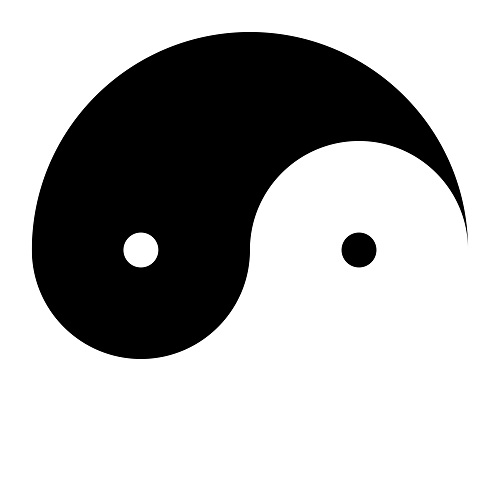
Every element of the symbol carries meaning. The outer circle represents the totality of existence — the whole within which yin and yang arise. The curved line dividing the two halves represents the dynamic, constantly shifting boundary between yin and yang — not a straight rigid division but a fluid, living relationship. The small black circle within the white half, and the small white circle within the black half, represent the seed of each quality within its opposite — a reminder that yin always contains the potential for yang and vice versa, and that each can transform into the other when conditions are right.
The symbol does not depict a static state but a dynamic, continuously rotating process — the eternal cycle of change, balance and transformation that governs all of nature and the human body alike.
5. Yin and yang characteristics
In traditional Chinese medicine, everything — from natural phenomena to body tissues, from the time of day to the nature of a disease — can be classified according to its relative yin or yang quality. The following table summarises the key characteristics associated with each:
| Yin | Yang |
|---|---|
| Female | Male |
| Moon | Sun |
| Water | Fire |
| Earth | Heaven |
| Night | Day |
| Midnight | Midday |
| Winter | Summer |
| Cold | Hot |
| Passive | Active |
| Interior | Exterior |
| Below | Above |
| Descending | Ascending |
| Substance, form | Function, activity |
| Nourishment | Transformation |
| Rest, sleep | Wakefulness, movement |
Women are considered predominantly yin in constitution, while men are predominantly yang — though all individuals contain both yin and yang qualities in varying proportions, and it is the relative balance between them that determines health. These classifications are always relative: what is yin in one context may be yang in another. The back of the body is more yang than the front; the exterior of the body is more yang than the interior; the upper body is more yang than the lower.
Yin and yang are deeply rooted in the observation of nature. Night-time, for example, is the time of yin — the period when we should be at our most inactive, resting and sleeping. When we habitually stay up late, work long hours into the night or disrupt our natural sleep patterns, we work against the laws of nature and deplete our yin. Over time, this damages our health in ways that TCM recognises as yin deficiency.
6. Yin and yang in the human body
In the human body, yin and yang manifest at every level — from the broad structure of the body to the finest details of organ function, fluid metabolism and emotional life.
Structurally, the exterior of the body (skin, muscles) is relatively more yang; the interior (organs, bones, deep tissues) is relatively more yin. The back of the body is more yang; the front more yin. The upper body is more yang; the lower body more yin.
Functionally, yang represents the body's warming, activating, transforming and protective capacities — the ability to generate warmth, circulate qi and blood, digest food, defend against external pathogens and maintain alertness and vitality. Yin represents the body's nourishing, cooling, moistening and anchoring capacities — the physical substance of the tissues and fluids, the ability to rest, regenerate and maintain emotional stability.
Both are essential and interdependent. Yang without sufficient yin becomes too hot, too active, too consuming — like a fire without fuel. Yin without sufficient yang becomes too cold, too static, too heavy — like water without heat, unable to move or transform. The healthy body maintains a dynamic equilibrium between the two, constantly adjusting to the demands of daily life, the changing seasons and the natural ageing process.
Qi itself has both yin and yang aspects. Yin qi nourishes and moistens; yang qi warms and activates. Together they circulate through the body's meridian system, sustaining the function of the internal organs and connecting the body's surface with its depths.
7. Yin and yang organs
In traditional Chinese medicine, the internal organs are classified according to yin and yang. This classification is based not primarily on their anatomical structure but on their energetic function within the body's overall system.
The yin organs (known as the zang organs) are the Heart, Liver, Spleen, Lung and Kidney. They are described as "solid" or "dense" organs — full of substance — and their primary function is to produce, store and regulate the body's fundamental vital substances: qi, blood, yin fluid and essence. The yin organs are the most important in TCM and are the organs most commonly addressed in treatment.
The yang organs (known as the fu organs) are the Small Intestine, Large Intestine, Gallbladder, Stomach, Urinary Bladder and the Triple Burner (San Jiao). They are described as "hollow" organs — empty vessels — and their primary function is to receive, transform and transport food, fluid and waste through the body. They are active, moving and transforming.
Each yin organ is paired with a corresponding yang organ, and together each pair governs a specific physiological system, emotional sphere and area of the body:
- Heart (yin) and Small Intestine (yang) — governs blood circulation, consciousness and the emotion of joy. Associated with the Fire element.
- Liver (yin) and Gallbladder (yang) — governs the smooth flow of qi and blood, tendons and the emotions of anger and frustration. Associated with the Wood element.
- Spleen (yin) and Stomach (yang) — governs digestion, the transformation of food into qi and blood, and the emotion of worry. Associated with the Earth element.
- Lung (yin) and Large Intestine (yang) — governs the breath, the skin and the emotions of sadness and grief. Associated with the Metal element.
- Kidney (yin) and Urinary Bladder (yang) — governs the body's fundamental essence (jing), reproduction, bone health and the emotions of fear and willpower. Associated with the Water element.
This organ pairing system is one of the foundations of Five Element theory, which maps the relationships between the organs, the emotions, the seasons and the natural world into a comprehensive framework for understanding health and disease.
8. Yin and yang imbalances
In TCM, most diseases can be understood as expressions of an imbalance between yin and yang. There are four primary patterns of imbalance, each with distinct symptoms and requiring a different therapeutic approach.
Yin deficiency
Yin deficiency occurs when the body's cooling, nourishing and moistening substance is depleted. Because yin normally keeps yang in check, a deficiency of yin allows yang to become relatively excessive — producing signs of heat that arise not from true excess of yang but from insufficient yin to restrain it. This pattern is known as "deficiency heat" or "empty heat" and is one of the most common patterns seen in modern clinical practice.
Common causes of yin deficiency include overwork, chronic stress, insufficient sleep, excessive sexual activity, prolonged illness and the natural process of ageing. Women are particularly susceptible to yin deficiency because blood — which is yin in nature — is regularly lost through menstruation.
A deficiency of yin can manifest as:
- Menopausal symptoms including hot flushes, night sweats and vaginal dryness
- Insomnia — particularly difficulty staying asleep or waking in the early hours
- Dry mouth, dry throat or dry eyes, particularly in the evening
- A sensation of heat in the palms, soles and chest (known as "five palm heat")
- Low-grade afternoon fever or feeling of heat in the afternoon and evening
- Night sweats
- Anaemia and blood deficiency
- High FSH levels and low AMH
- Poor egg quality
- Recurrent miscarriage
- Skin conditions including eczema and psoriasis driven by dryness and heat
- Tinnitus and dizziness
Yang deficiency
Yang deficiency occurs when the body's warming, activating and transforming energy is insufficient. Because yang normally warms the body and drives its physiological functions, a deficiency of yang produces signs of cold, fatigue, sluggishness and reduced function. This pattern becomes increasingly common with age and is often seen following prolonged illness, exhaustion or chronic overwork.
A deficiency of yang can manifest as:
- Persistent feeling of cold, particularly in the back, knees, abdomen and feet
- Fatigue, low energy and lack of motivation
- Burn out and adrenal exhaustion
- Frequent, clear urination
- Loose stools or digestive weakness
- Oedema and fluid retention
- Raynaud's disease and cold extremities
- Low testosterone levels and reduced libido
- Erectile dysfunction and impotence
- Cold uterus and irregular or painful menstrual cycles
- Depression and low mood accompanied by fatigue and cold
Excess yang
Excess yang occurs when the body has too much heat, often as a result of an external pathogenic factor (such as a febrile infection), or from internal factors such as emotional constraint, dietary excess or prolonged stress generating heat within the liver or stomach. Signs include fever, inflammation, redness, restlessness, anxiety and aggressive emotions such as anger and irritability.
Excess yin
Excess yin occurs when cold or dampness accumulates in the body to a pathological degree. This is most often caused by exposure to cold and damp environments, consumption of cold or raw foods, or insufficient physical activity. Signs include a feeling of heaviness, swelling, copious clear or white discharge, digestive sluggishness and joint pain that is worse in cold and damp conditions.
9. How TCM restores yin and yang balance
The therapeutic objective in all traditional Chinese medicine treatment is to restore the harmonious balance of yin and yang within the body. Different TCM therapies address different aspects of this imbalance, and most conditions benefit from a combination of approaches.
Acupuncture works primarily by regulating the flow of qi through the meridian system, which in turn influences the balance of yin and yang in the relevant organ systems. Specific acupuncture points are selected to nourish yin, strengthen yang, clear heat, resolve dampness or promote the smooth flow of qi and blood, depending on the patient's individual pattern of imbalance.
Chinese herbal medicine is particularly powerful for addressing yin and yang imbalances, as herbs can directly nourish and replenish yin substance, warm and strengthen yang qi, clear excess heat or resolve cold and dampness in ways that needles alone cannot always achieve. Herbs are classified according to their nature (cooling, neutral or warming), flavour and organ affinity, and are combined into bespoke formulas tailored to each patient's specific pattern.
Moxibustion is the TCM therapy most specifically suited to treating yang deficiency. The warm, penetrating heat of burning mugwort directly supplements yang qi, disperses cold and dampness and warms the meridians. It is particularly effective for conditions characterised by cold, fatigue, poor circulation and reproductive weakness.
Dietary therapy uses food as medicine to support the rebalancing of yin and yang over time. Cooling foods such as cucumber, peppermint and green tea nourish yin and clear heat; warming foods such as ginger, cinnamon and lamb strengthen yang and dispel cold. TCM dietary advice is always tailored to the individual's pattern rather than being based on generalised nutritional rules.
If you would like to know more about how I can help restore your yin and yang balance, you can schedule a consultation at my clinics in Wokingham, Berkshire, or book an online consultation.
10. Commonly asked questions about yin and yang
What does it mean to be yin deficient?
Yin deficiency means that the body's cooling, nourishing and moistening substance has been depleted. Because yin keeps yang in check, a deficiency of yin allows yang to become relatively too active, generating signs of "empty heat" — warmth that arises not from true excess but from insufficient cooling. Common symptoms include hot flushes, night sweats, dry mouth and eyes, insomnia, afternoon heat and tinnitus. It is particularly common in women approaching the menopause and in those who have been chronically overworking or under-sleeping.
What does it mean to be yang deficient?
Yang deficiency means that the body's warming, activating energy is insufficient. The primary signs are persistent cold — particularly in the lower back, knees, abdomen and extremities — along with fatigue, low motivation, digestive weakness and poor circulation. It is more common in men and becomes increasingly prevalent with age. Moxibustion and warming Chinese herbal formulas are the most effective TCM treatments for yang deficiency.
Can you be both yin and yang deficient at the same time?
Yes — because yin and yang are interdependent, a prolonged or severe deficiency of one will eventually deplete the other. A patient with long-standing yin deficiency may develop signs of yang deficiency as the underlying substance that supports yang is exhausted; similarly, a patient with chronic yang deficiency may develop yin deficiency as the warmth needed to generate and circulate yin is insufficient. These combined patterns are common in older patients and in those with long-standing chronic illness, and require a carefully balanced treatment approach.
How is yin and yang imbalance diagnosed?
A TCM practitioner diagnoses yin and yang imbalance through a combination of detailed questioning, tongue examination and pulse-taking. The tongue provides a map of the body's internal state — a pale tongue suggests yang or qi deficiency, while a red tongue with little or no coating suggests yin deficiency. The pulse at twelve positions on both wrists provides information about the state of each organ system's yin and yang. Together these diagnostic tools allow the practitioner to identify the specific pattern of imbalance and formulate an appropriate treatment plan.
How does yin and yang relate to fertility?
Yin and yang play a central role in fertility from a TCM perspective. Yin is closely related to blood and essence — the substances that nourish the egg, support the uterine lining and sustain early pregnancy. Yang provides the warmth needed to promote ovulation, support implantation and maintain a healthy pregnancy. Both are required in balance for optimal reproductive function. Many common fertility problems — including low AMH, poor egg quality, irregular cycles and recurrent miscarriage — can be understood and treated through the lens of yin and yang imbalance.
How does yin and yang relate to the Five Elements?
Yin and yang theory and Five Element theory are the two most important theoretical frameworks in traditional Chinese medicine and are deeply interconnected. Each of the Five Elements — Wood, Fire, Earth, Metal and Water — has both a yin and a yang expression in the body (the yin and yang organ pairs described above). Yin and yang theory provides the broad diagnostic framework; Five Element theory adds a further layer of specificity, mapping the relationships between the organ systems, the emotions, the seasons and the natural world.
References
- Huang Di Nei Jing Su Wen (The Yellow Emperor's Classic of Internal Medicine). (~300 BCE). Beijing: People's Medical Publishing House.
- Unschuld, P. U. (2003). Huang Di Nei Jing Su Wen: Nature, Knowledge, Imagery in an Ancient Chinese Medical Text. Berkeley: University of California Press.
- Maciocia, G. (2015). The Foundations of Chinese Medicine: A Comprehensive Text (3rd ed.). Edinburgh: Churchill Livingstone Elsevier.
- Kaptchuk, T. J. (2000). The Web That Has No Weaver: Understanding Chinese Medicine (2nd ed.). New York: McGraw-Hill.
- Porkert, M. (1974). The Theoretical Foundations of Chinese Medicine: Systems of Correspondence. Cambridge, MA: MIT Press.
- Wiseman, N. & Ye, F. (1998). A Practical Dictionary of Chinese Medicine (2nd ed.). Brookline: Paradigm Publications.
- Yanchi, L. (1988). The Essential Book of Traditional Chinese Medicine, Vol. 1: Theory. New York: Columbia University Press.
- Greten, H. J., Efferth, T., & Becker, S. (2021). Understanding traditional Chinese medicine therapeutics: an overview of the basics and clinical applications. Healthcare, 9(3), 257. doi:10.3390/healthcare9030257
- Vickers, A. J., Vertosick, E. A., Lewith, G., MacPherson, H., Foster, N. E., Sherman, K. J., ... & Linde, K. (2018). Acupuncture for chronic pain: update of an individual patient data meta-analysis. The Journal of Pain, 19(5), 455–474. doi:10.1016/j.jpain.2017.11.005
- Smith, C. A., Armour, M., Lee, M. S., Wang, L. Q., & Hay, P. J. (2018). Acupuncture for depression. Cochrane Database of Systematic Reviews, (3), CD004046. doi:10.1002/14651858.CD004046.pub4
- Xu, M., Deng, H., & Li, S. (2013). Effect of umbilicus moxibustion therapy on physical conditions of yang-deficiency volunteers. Zhongguo Zhen Jiu, 33(1), 19–22. PMID:23342783
- Kim, S. Y., Lee, H., Choi, T. Y., Park, J. E., & Lee, M. S. (2011). The effectiveness of moxibustion: an overview during 10 years. Evidence-Based Complementary and Alternative Medicine, 2011, 306515. doi:10.1093/ecam/nep163
- Wang, L. L., Xiang, Y. G., Tan, L., Zhu, J. Y., Ren, Z. X., Ma, X. Y., & Wu, Y. R. (2021). Acupuncture-moxibustion treatment by stages based on the theory of "transformation of yin and yang" for premature ovarian insufficiency. Zhongguo Zhen Jiu, 41(7), 742–746. doi:10.13703/j.0255-2930.20200627-k0001
- Cheong, K. B., Zhang, J. P., Huang, Y., & Zhang, Z. J. (2013). The effectiveness of acupuncture in prevention and treatment of postoperative nausea and vomiting — a systematic review and meta-analysis. PLoS ONE, 8(12), e82474. doi:10.1371/journal.pone.0082474
- National Institute for Health and Care Excellence (NICE). (2021). Chronic pain (primary and secondary) in over 16s: assessment of all chronic pain and management of chronic primary pain. NICE guideline [NG193]. London: NICE.















